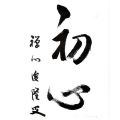

Postscript by Master Ouyi (蕅益大師)
The sutras state: “In the Age of Dharma Decline, among hundreds of millions who practice, rarely does even one attain the Way; only by relying on the practice of reciting the Buddha’s name can one achieve deliverance.” Alas! That very time is now upon us. If we forsake this inconceivable Dharma gate, what other paths could possibly suffice?
When I first entered monastic life, I prided myself on the Chan tradition and looked down upon the doctrinal teachings, foolishly believing that the practice of reciting the Buddha’s name was merely a provisional expedient for those of middling or inferior capacity. Later, following a severe illness, I resolved to seek rebirth in the Pure Land of Ultimate Bliss.
Upon further study of the commentaries by Master Zhi Li, Master Chuan Deng and Master Lian Chi, I finally realized that the Samadhi of Buddha Remembrance is truly the supreme “Jewel-King.” Only then did I wholeheartedly commit to reciting the Buddha name — a resolve so firm that not even a team of ten thousand oxen could pull me away from it.
My friend Qubing, a long-time practitioner of Pure Land teachings, wished to have the essential purport of the Amitabha Sutra clearly elucidated in a concise manner, and thus requested that I compose an “Essential Explanation.” Desiring that all sentient beings throughout the Dharma realm might share in rebirth in the Pure Land of Ultimate Bliss, I could not refuse this request. I took up my brush on the twenty-seventh day of the ninth lunar month (October 24, 1647) and completed the manuscript on the fifth day of the tenth month (November 1st, 1647) — finishing the work in just nine days.
My prayer is that every word and phrase of it may serve as provisions for the journey to enlightenment, and that all who see or hear this text may attain the stage of non-retrogression. May both faith and doubt plant seeds of the Way; may both praise and slander lead equally to liberation. I humbly beseech the Buddhas and Bodhisattvas to accept and bear witness to this work, and I ask my fellow practitioners and friends to rejoice in it and lend their spiritual support.
蕅益大師跋
經云:末法億億人修行,罕一得道,唯依念佛得度。嗚呼!今正是其時矣。捨此不思議法門,其何能淑。旭出家時,宗乘自負,藐視教典。妄謂持名,曲為中下。後因大病,發意西歸。復研《妙宗》、《圓中》二鈔,及雲棲《疏鈔》等書,始知念佛三昧,實無上寶王,方肯死心執持名號,萬牛莫挽也。吾友去病,久事淨業,欲令此經大旨,辭不繁而炳著,請余為述要解。余欲普與法界有情同生極樂,理不可卻。舉筆于丁亥九月二十有七,脫稿於十月初五,凡九日告成。所願一句一字,咸作資糧。一見一聞,同階不退。信疑皆植道種,讚謗等歸解脫。仰唯諸佛菩薩攝受證明,同學友人隨喜加被。西有道人蕅益智旭閣筆故跋,時年四十有九。
Essence of the Amitabha Sutra
All Buddhas took pity on the deluded sentient beings and put forth transformative teachings according to sentient beings’ various potentials. All teachings derive from the same source and lead to the same destination, although different expedients are employed.
Among all the expedients, if we seek the most direct and the most complete, none is as good as seeking birth in the Pure Land through Buddha-remembrance. Among all the methods of Buddha-remembrance, if we seek the simplest and the soundest, none is as good as reciting the Buddha-name with faithfulness, wishfulness, and mindfulness.
This is why the ancients took only the Amitabha Sutra as their daily routine study, out of the three Pure Land scriptures that have been circulating side by side. The method of Buddha-name recitation applies to all people, regardless of whether their capacities are high, medium, or lower. It encompasses both the cultivation of practice and the contemplation of principle, embracing both Chan Buddhism and Scriptural Buddhism, missing nothing out. Indeed, this method is simply inconceivable!
Since ancient times there has been no lack of commentaries on the Amitabha Sutra, yet most of them have fallen into oblivion. The only exceptions are Master Lian Chi’s commentary, which is extensive and subtle, as well as Master Chuan Deng’s commentary, which is profound and erudite. They are like the sun and the moon that can be seen by anyone with vision. However, their literary style is too elaborate, complex, and ultimately unfathomable, beyond the reach of beginners whose level and stage are yet to develop. Therefore, I have put aside my qualms about my own mediocrity and ignorance, and set out to compose another commentary, explaining the essential points of the Amitabha Sutra. I would not dare trying to diverge from the grand masters, nor would I presume that I could equal them. Think about this – viewing Mount Lu from the side reveals a peak, while viewing it from the front reveals a ridge; though no perspective captures the mountain’s true essence in its entirety, each nonetheless represents a genuine, firsthand encounter with it.
To explicate the text of the Amitabha Sutra, one must go through five layers (to be continued …)
(1) An Explanation of the Title
佛說阿彌陀經要解
蕅益大師著
原夫諸佛憫念群迷,隨機施化。雖歸元無二,而方便多門。然於一切方便之中,求其至直捷、至圓頓者,則莫若念佛求生淨土。又於一切念佛法門之中,求其至簡易、至穩當者,則莫若信願專持名號。是故淨土三經並行於世,而古人獨以《阿彌陀經》列為日課。豈非有見於持名一法,普被三根,攝事理以無遺,統宗教而無外,尤為不可思議也哉!古來註疏,代不乏人,世遠就湮,所存無幾。雲棲和尚著為《疏鈔》,廣大精微。幽谿師伯述《圓中鈔》,高深洪博。蓋如日月中天,有目皆睹,特以文富義繁,邊涯莫測,或致初機淺識,信願難階。故復弗揣庸愚,再述《要解》。不敢與二翁競異,亦不必與二翁強同。譬如側看成峰,橫看成嶺,縱皆不盡廬山真境,要不失為各各親見廬山而已。將釋經文,五重玄義。