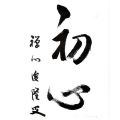

Verses on the Faith Mind
(By Seng Can, the 3rd Patriarch of Chan Buddhism in China, 529-606 C.E.)
The Great Way is not difficult
for those who have no preferences.
When love and hate, like and dislike, longing and dreading
are all absent,
Everything becomes clear and undisguised, light and carefree,
at ease and in peace.
Make the smallest distinction, missing the way by a hairbreadth
however, heaven and earth are set infinitely apart.
If you wish to see the truth,
then hold no opinions for or against anything.
If you wish to see a thing as it is,
do not affirm or oppose it.
If you want something to appear or disappear,
be neither for nor against.
To set up what you like against what you dislike,
is the dis-ease of the mind.
Without recognizing this principle, it is useless to practice quietude.
When the deep meaning of things is not understood,
the mind’s essential peace is disturbed to no avail.
The Way is perfect like vast space,
where nothing is lacking and nothing in excess.
Indeed, it is due to our choosing to accept or reject,
that we do not see the true nature of things.
Do not chase after external conditions,
nor dwell on internal problems.
Live neither in the entanglement of outer things,
nor in inner feelings of emptiness.
Be serene in the equality of things, letting it be,
and all one-sided views will disappear by themselves.
When you try to stop activity by passivity,
your very effort fills you with activity.
When you get attached to emptiness,
you turn your back on it.
As long as you remain in one extreme or the other,
you will never know Oneness.
Those who do not live in the Middle Way
fail in both activity and passivity.
To deny the reality of things is to miss their reality.
Also, to assert the emptiness of things is to miss their reality.
The more you talk and think about it,
the further astray you wander from the truth.
Stop talking and thinking,
everything becomes self-evident,
and there is nothing you do not see.
Returning to the root, you attain enlightenment.
Pursuing appearances, you miss the source.
Even one moment of reversing the light
transforms the previous impression and reveals it all –
everything was illusory, a product of deluded views.
At the moment of inner enlightenment,
there is a going beyond appearance and emptiness.
The changes that appear to occur in the empty world – we call them real only because of our ignorance.
Do not harbor dualistic views; refrain from following them.
No need to seek what’s real; simply extinguish your views.
Do not search for the truth; only cease to cherish opinions.
The slightest idea of right and wrong fragments the mind –
two views come from one; do not cling to even one.
When the single mind is not born,
the myriad things do not arise – no mind, no birth.
Do not remain in the dualistic state;
do not abide in dualistic views.
If there is even a trace of this and that,
the mind-essence is lost in confusion.
As soon as there is right and wrong, gain and loss, good and bad,
the mind is off-track and scattered.
Although all dualities come from the One,
do not be attached even to this One.
When one mind does not arise,
myriad dharmas have no flaws –
no flaws, no dharmas;
no arising, no coming into being;
no mind, no birth.
When the mind exists undisturbed in the Way,
nothing in the world can offend.
And when a thing can no longer offend,
it ceases to exist in the old way.
When no discriminating thoughts arise,
the old mind ceases to exist.
The subject is extinguished with the object.
When thought objects vanish, the thinking subject vanishes;
as when the mind vanishes, objects vanish.
Things are object because of the subject (mind);
the mind (subject) is such because of things (object).
Know that subject and object are one emptiness.
In one emptiness the two are the same, containing all phenomena.
Understand the relativity of subject and object,
and the basic reality: the unity of emptiness.
In this Emptiness the two are indistinguishable,
and each contains in itself the whole world.
If you do not discriminate between coarse and fine,
how can you get attached to either?
And you will not be tempted to prejudice and opinion.
To live in the Great Way is neither easy nor difficult,
just relax and surrender with ease.
Those with limited views are fearful and irresolute, going in circles.
The faster they hurry, the slower they go,
and clinging cannot be limited.
Being attached to anything, the mind enters a deviant path.
Even to be attached to the idea of enlightenment is to go astray.
Surrender with ease. Let things be in their own way,
and there will be neither coming nor going.
Obey the nature of things – follow your own nature,
and you will walk freely without any fear.
When the mind is off-track and thoughts are scattered,
the truth is hidden, for everything is murky and unclear.
And the burdensome practice of judging,
brings annoyance and weariness.
It is simply not good to weary the spirit,
and sinking into stupor is just as bad.
What benefit can be derived from distinctions?
Do not favor the single path,
nor disfavor the six-sense objects.
The objects of the senses are necessary for awakening.
If you wish to move in the One Way,
do not dislike even the world of senses and ideas.
The wise have no motives and strive to no goals –
they do not make things happen.
Fools are caught by doing –
they put themselves in bondage and fetter themselves.
There is one Dharma, not many.
One dharma is not different from another.
But the deluded mind clings to whatever it desires
and engages in discrimination –
distinctions arise from the clinging needs of the ignorant.
To seek Mind with the discriminating mind is the greatest of all mistakes.
Enlightenment does not pick and choose –
in enlightenment there are no likes and dislikes.
All things have two sides.
The duality of all things comes from ignorant inference –
mistakenly and constantly, you waver between this and that.
All dualities are like dreams, phantoms, flowers in air –
it’s foolish to try to grasp them.
Gain and loss, right and wrong, good and bad –
discard them all at once; such thoughts must finally be abolished.
If the eyes do not close, all dreams will naturally cease.
If the mind makes no distinctions, all dharmas are of one suchness –
the ten thousand things are as they are, of single essence.
To understand the mystery of this One-essence,
is to be released from all entanglements.
When all things are seen equally,
the timeless Self-essence is reached.
No comparisons or analogies are possible,
in this causeless, relationless state.
Consider movement stationary, and the stationary in motion –
both movement and stillness disappear.
When such dualities cease to exist, Oneness itself cannot exist.
To this ultimate finality, no law or description applies.
Develop a mind of equanimity, and all deeds are put to rest.
Anxious doubts are completely cleared,
with nothing lingering behind and holding back.
For the unified mind in accord with the Way,
all self-centered striving ceases.
Doubts and irresolution vanish, and life in true faith is possible.
With a single beat we are freed from bondage –
nothing clings to us, and we hold to nothing.
Space illuminates itself, not requiring mental effort.
All is empty, clear, self-illuminating,
with no exertion of the mind’s power.
It is not a place of thinking,
difficult for reason and emotion to fathom.
Here knowledge, thought, feeling, and imagination are of no value.
In this world of suchness, there is neither self nor other-than-self.
To come directly into harmony with this reality,
just say “not two” when doubt rises.
In this “not two” all things are in unity,
nothing is separate, and nothing is excluded.
No matter when or where,
enlightenment means entering this truth.
And this truth is beyond extension or diminution in time and space –
in it a single thought is ten thousand years.
Emptiness here, emptiness there –
abiding nowhere yet everywhere.
The infinite universe is always right before your eyes,
infinitely large and infinitely small.
The smallest is the same as the largest,
and the largest is the same as the smallest –
no difference, for all definitions have vanished.
In the realm where delusion is cut off,
no boundaries are seen.
So too with Being and Nonbeing.
Existence is emptiness; emptiness is existence.
One is everything; all is one.
Don’t waste time in doubts and arguments
that have nothing to do with the Way.
One thing and all things move among,
intermingling without distinction.
To live in this realization,
is to be without anxiety about non-perfection.
To live in this faith is the road to non-duality,
for the non-dual is one with the trusting mind.
Words are imperfect.
The Way is beyond language.
There is no past, no future, no present.
信心銘
三祖僧璨
至道無難,唯嫌揀擇。但莫憎愛,洞然明白。毫釐有差,天地懸隔。
欲得現前,莫存順逆。違順相爭,是為心病。不識玄旨,徒勞念靜。
圓同太虛,無欠無餘。良由取捨,所以不如。莫逐有緣,勿住空忍。
一種平懷,泯然自盡。止動歸止,止更彌動。唯滯兩邊,寧知一種。
一種不通,兩處失功。遣有沒有,從空背空。多言多慮,轉不相應。
絕言絕慮,無處不通。歸根得旨,隨照失宗。須臾返照,勝卻前空。
前空轉變,皆由妄見。不用求真,唯須息見。二見不住,慎勿追尋。
纔有是非,紛然失心。二由一有,一亦莫守。一心不生,萬法無咎。
無咎無法,不生不心。能隨境滅,境逐能沉。境由能境,能由境能。
欲知兩段,元是一空。一空同兩,齊含萬像。不見精粗,寧有偏黨。
大道體寬,無易無難。小見狐疑,轉急轉遲。執之失度,心入邪路。
放之自然,體無去住。任性合道,逍遙絕惱。繫念乖真,沉惛不好。
不好勞神,何用疎親。欲趣一乘,勿惡六塵。六塵不惡,還同正覺。
智者無為,愚人自縛。法無異法,妄自愛著。將心用心,豈非大錯。
迷生寂亂,悟無好惡。一切二邊,妄自斟酌。夢幻空華,何勞把捉。
得失是非,一時放卻。眼若不眠,諸夢自除。心若不異,萬法一如。
一如體玄,兀爾忘緣。萬法齊觀,歸復自然。泯其所以,不可方比。
止動無動,動止無止。兩既不成,一何有爾。究竟窮極,不存軌則。
啟心平等,所作俱息。狐疑盡淨,正信調直。一切不留,無可記憶。
虛明自然,不勞心力。非思量處,識情難測。真如法界,無他無自。
要急相應,唯言不二。不二皆同,無不包容。十方智者,皆入此宗。
宗非促延,一念萬年。無在不在,十方目前。極小同大,妄絕境界。
極大同小,不見邊表。有即是無,無即是有。若不如是,必不須守。
一即一切,一切即一。但能如是,何慮不畢。信心不二,不二信心。
言語道斷,非去來今。


 Buddha Mind